
Lab grown diamonds are diamonds produced in controlled laboratory environments rather than mined from the earth. At the material level, they are the same as natural diamonds. Both consist of crystallized carbon arranged in the same structure, which gives a diamond its hardness, durability, and light performance.
The only difference between lab diamonds and earth mined diamonds lies in their origin. Earth mined diamonds are formed deep underground over geological time, while laboratory diamonds are created through modern technology. Their optical properties and crystal structure are identical, which is why they display the same beauty, brilliance, and sparkle as mined diamonds.
During the custom design process at Alexis Gallery, both lab grown and earth mined diamonds can be considered when selecting a centre stone. Here is everything you need to know about lab grown diamonds to make an informed decision when creating your dream ring.
Lab grown diamonds begin with a small diamond seed. This seed provides the crystal structure that guides growth. Carbon atoms attach to the seed inside specialized equipment and expand the crystal outward until a larger diamond forms.
Two methods are responsible for most laboratory diamonds used in jewellery today:
The High Pressure High Temperature method recreates the conditions under which natural diamonds formed. A diamond seed sits inside a press that produces extreme pressure and heat. Carbon material inside the chamber crystallizes onto the seed and the diamond grows.
HPHT technology dates back to the 1950s and was originally developed for industrial diamond production – think diamond drill tips.
Chemical Vapor Deposition uses a sealed chamber filled with carbon-rich gas. Energy introduced into the chamber separates the carbon atoms from the gas. These atoms attach to the diamond seed and the crystal grows layer by layer.

Some laboratory diamonds undergo additional processing after growth. These steps may influence colour or clarity and are documented in the diamond’s grading report.

Lab grown diamonds are evaluated using the same grading framework applied to natural diamonds. Carat weight, colour, clarity, and cut all influence price and appearance.
Laboratory production allows diamonds to be grown in controlled facilities rather than formed underground. As crystal growth technology advanced, lab diamonds became more widely available, which is why lab grown diamonds are typically offered at a more affordable price than earth mined diamonds.
Especially with larger carat weights, the price difference between lab grown and earth mined diamonds splits quite aggressively. Where a ring featuring a 2.00 ct. earth mined diamond could demand a budget of $20,000-35,000 CAD, a lab grown equivalent could be achieved for closer to $5,000-5,800.
There are typically three main factors that sway people towards lab diamonds over earth mined diamonds.
For many people, having a ring that represents their values be it environmentalism, concerns over labour practices, or both is what drives them to choose a lab diamond for their engagement ring. While most lab diamonds don’t have a net-zero environmental impact, people appreciate that wildlife doesn’t need to be disrupted with mining.
The innovation that lab diamonds represent appeals to many. Be it fiances-to-be from a science or technology background, or just people who always have their finger on the pulse of new innovations, it’s a draw for many.
The reality is that the cost of living has increased to the point that many couples can’t allocate the budget required to achieve an earth mined diamond anymore. They’re prioritizing practical expenses like rent or mortgage payments with other values like travel, investing and wedding planning. Lab diamonds allow them to balance many priorities without sacrificing on size or diamond quality.
Scientists began experimenting with diamond synthesis in the early twentieth century. In 1954, researchers at General Electric successfully produced diamonds using the High Pressure High Temperature method.
Early lab diamonds were primarily used for industrial tools and abrasives because of their hardness.
Improvements in crystal growth technology eventually produced stones suitable for jewellery. Commercial availability increased during the 2010s as production methods advanced.
Today laboratory diamonds appear in many forms of fine jewellery, including engagement rings and pieces designed for everyday wear or special occasions.
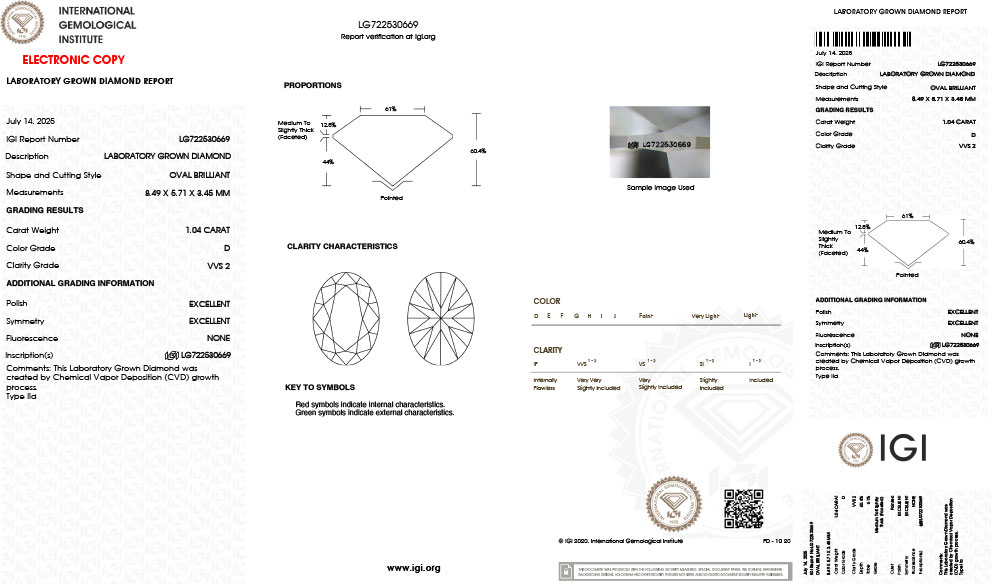

Diamonds are evaluated by independent gemological laboratories by qualified appraisers who analyze measurable characteristics and issue grading reports documenting the diamond’s quality.
These reports typically record carat weight, colour, clarity, cut grade, and the stone’s measurements. The report may also note visible inclusions and other characteristics used to describe the diamond.
For lab diamonds, the report clearly identifies the stone as laboratory grown – typically noted with the letters “LG” preceding the certification number. The growth method is also usually noted in the comments section of the report. All certified diamonds also carry a microscopic laser inscription on the girdle that corresponds to the grading report number, allowing the diamond to be matched directly to its documentation.
At Alexis Gallery, grading reports provide useful reference information during the diamond selection process. We also examine diamonds directly to show you the stones in person and how they compare to one another before they become part of your custom ring.
Yes. Lab grown diamonds share the same chemical composition and crystal structure as mined diamonds. They are composed of crystallized carbon and display the same hardness and optical behaviour – ie. sparkle and brilliance. To the naked eye, they appear the same as mined diamonds because their structure and visual properties are the same, and can only truly be set apart from an earth mined diamond by an appraiser using specialized equipment, or by reviewing its certification documentation.
In most cases, determining a diamond’s origin requires specialized gemological equipment designed to detect growth patterns and trace characteristics. These tools are used by grading laboratories, appraisers and trained gemologists. Standard visual inspection alone is not sufficient to reliably determine whether a diamond formed in nature or in a laboratory.
Yes. Laboratory diamonds are evaluated using the same grading framework applied to natural diamonds. Grading laboratories assess carat weight, colour, clarity, and cut quality, then document these characteristics in a grading report. This report provides a standardized description of the diamond’s measurable qualities.
Yes. Lab grown diamonds are a popular choice for engagement rings and other fine jewellery. According to the Real Weddings Study, 61% of couples opted for lab diamonds for their engagement rings in 2025. In custom ring design, we discuss your preference of stone origin early in the process. If you’re new to the topic, we’ll help with education and resources to help you make an informed choice that supports your values and vision for your ring.
Yes. During the custom design process at Alexis Gallery, we curate diamonds that match your vision and budget for your ring. Lab grown diamonds can be part of that selection. Each stone is examined alongside its grading documentation, as part of our curation process, before it is considered for a custom ring.
The main difference between lab grown and earth mined diamonds is how they form. Their structure and appearance remain the same, which is why many clients see them as an affordable alternative when selecting a centre stone.
Lab grown diamonds are one option available when designing a ring. At Alexis Gallery, every diamond or gemstone is sourced specifically for each client and reviewed to our exact standards by our team of experts.
During the process we may explore shapes such as oval, round, emerald, and radiant; metals like gold or platinum; and how the ring will pair with your future wedding band.
If you are ready to begin, we invite you to discover Alexis Gallery, and the personalized experience that we offer. Book a phone consultation today to start designing a custom ring to mark this important moment.